
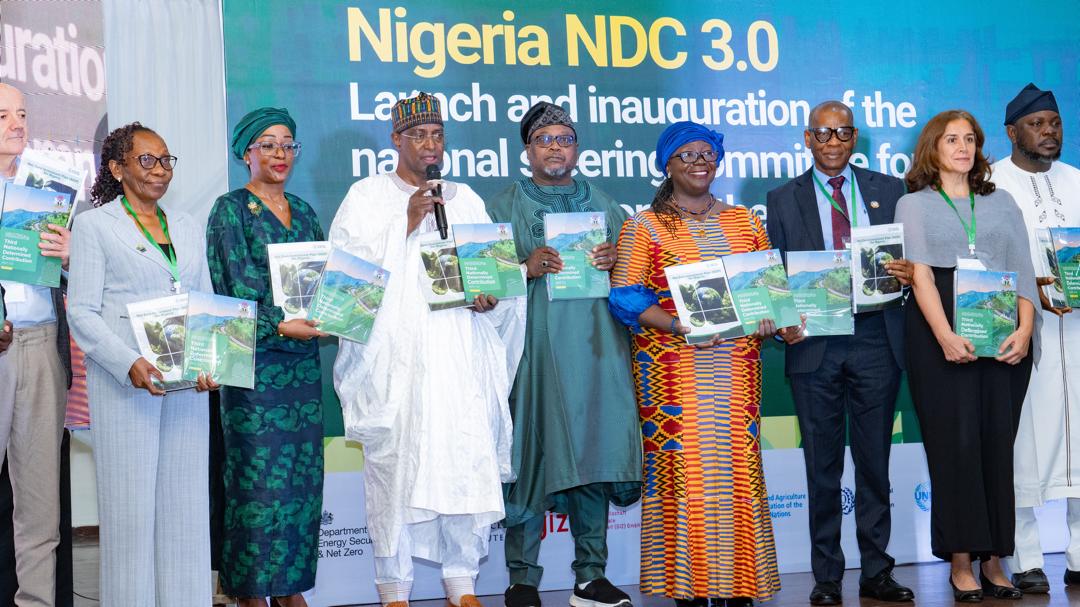
Federal Government targets greenhouse gas emissions and climate resilience as Nigeria debuts NDC 3.0 in Abuja.
The Federal Government of Nigeria has pledged to cut greenhouse gas emissions from the livestock sector and strengthen climate resilience as the country begins implementing its Third Nationally Determined Contribution, known as NDC 3.0.
Minister of Livestock Development Idi Mukhtar Maiha made the announcement on Thursday in Abuja during the official launch of NDC 3.0 and the inauguration of the National Steering Committee for the implementation of the NDC and Net-Zero Investment Plan.
The strategic move aims to safeguard food security, reduce poverty, and accelerate economic growth while combating environmental threats, according to information published by The Sun Nigeria.
Climate-Smart Implementation Plan for Livestock
Minister Idi Mukhtar Maiha warned that rising temperatures, droughts, floods, water scarcity, pasture degradation, and shifting disease patterns threaten animal health, productivity, pastoral livelihoods, and the stability of livestock value chains across the nation.
To combat these environmental pressures, the Ministry of Livestock Development is pursuing low-emission production through a dedicated Climate-Smart Implementation Plan under the broader National Livestock Growth Acceleration Strategy.
The comprehensive plan covers animal nutrition, feed conversion efficiency, genetics, animal health services, herd management, and manure management. These measures are specifically designed to cut emissions while raising overall productivity and profitability.
Adaptation Strategies and Digital Weather Infrastructure
On the adaptation front, the ministry is actively working on sustainable water supply, fodder development, and climate-resilient feed systems in selected grazing reserves and designated Livestock Development Centres throughout the country.
Additional efforts focus heavily on robust disease surveillance, modern health infrastructure, and early-warning systems to protect herds against climate-induced vulnerabilities and shifting epidemiological patterns.
To drastically improve local climate data, the ministry is developing a specialized livestock measurement, reporting, verification, and certification system while carrying out a comprehensive methane baseline survey.
Furthermore, five digital weather stations have been successfully installed to track critical environmental metrics, including atmospheric pressure, wind speed, humidity, and soil conditions.
Economy-Wide Targets and Net-Zero Ambitions
Director-General of the National Council on Climate Change Mrs Omotenioye Majekodunmi emphasized that the national focus must shift permanently from announcing commitments to active implementation and measurable results.
She stated that the newly launched NDC 3.0 sets an ambitious economy-wide target of cutting emissions by 32 percent by 2035, relative to a 2018 base year, on the ultimate path to achieving net zero by 2060.
Majekodunmi called for credible project pipelines, transparent operational programmes, and absolute policy certainty to successfully attract essential public and private investment into the green transition.
Development Partners and Multi-Sectoral Collaboration
Secretary to the Government of the Federation Senator George Akume, represented at the event by Professor Babatunde Bolaji Bernard, noted that the NDC should be treated as a primary national development instrument.
Under this governance approach, vital climate priorities must be built directly into national policies, government budgets, critical infrastructure projects, and broader investment decisions.
UNDP Resident Representative in Nigeria Ms Elsie Gyekyewaa Attafuah stressed that official climate policy must produce tangible, everyday improvements in the lives of ordinary citizens.
Other key development partners present at the launch strongly stressed the urgent need for international cooperation, technical assistance, climate finance, and institutional capacity-building.
Frequently Asked Questions
What is Nigeria NDC 3.0 and what are its main targets?
Nigeria NDC 3.0 is the country Third Nationally Determined Contribution, which sets an economy-wide target of cutting greenhouse gas emissions by 32 percent by 2035 relative to a 2018 base year, moving toward net zero by 2060.
Who announced the climate-smart livestock plan in Nigeria?
The plan was announced by the Minister of Livestock Development, Idi Mukhtar Maiha, during the official launch of NDC 3.0 and the National Steering Committee in Abuja.
How does the Ministry of Livestock Development plan to reduce emissions?
The ministry is implementing a Climate-Smart Implementation Plan focusing on animal nutrition, feed conversion efficiency, genetics, animal health services, herd management, manure management, and methane baseline surveys.
What role does the National Council on Climate Change play in NDC 3.0?
Led by Director-General Mrs Omotenioye Majekodunmi, the National Council on Climate Change oversees the transition from ambition to delivery, ensuring governance and measurable emission-reduction results.
